Irving, Texas · Dallas County · All 6 residential ZIPs
Water Damage Restoration in Irving, TX
A split supply line, a failed water heater, a ceiling that started dripping overnight, or water that came in off the roof during a spring storm. Tell us what happened and where you are, and we connect you with an independent restoration provider covering your ZIP code.
Water Damage Restoration Pros is a referral service. We connect you with independent restoration providers. Service availability, response time, pricing, licensing and the work performed are the responsibility of the provider, not of this website.
Water moves sideways on a slabIrving homes are slab-on-grade. Water spreads under flooring and cabinets long before it shows on the surface.
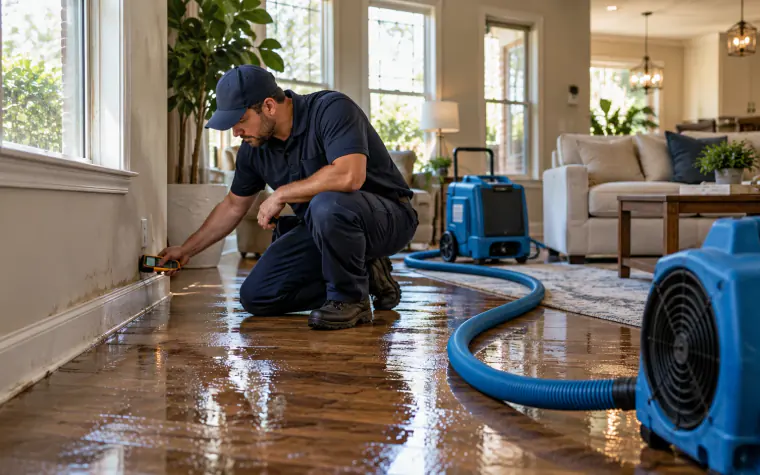
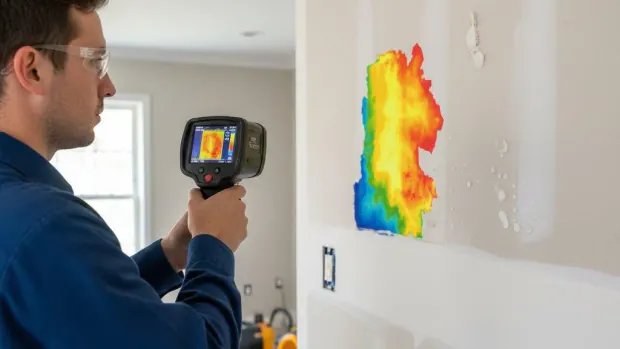
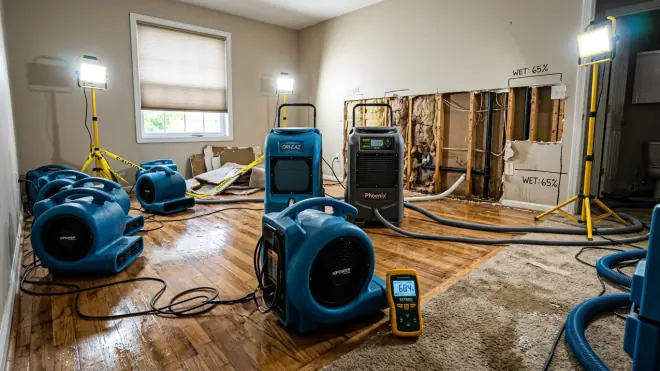
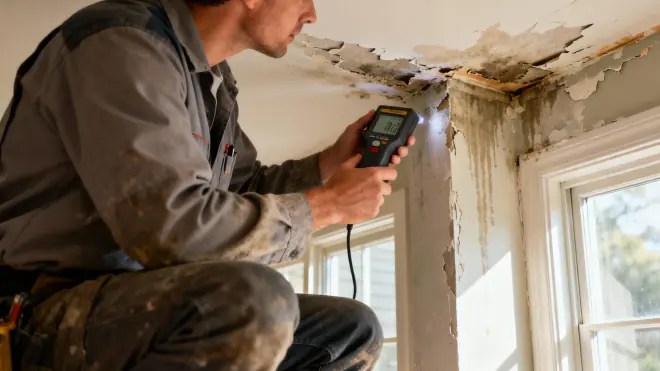
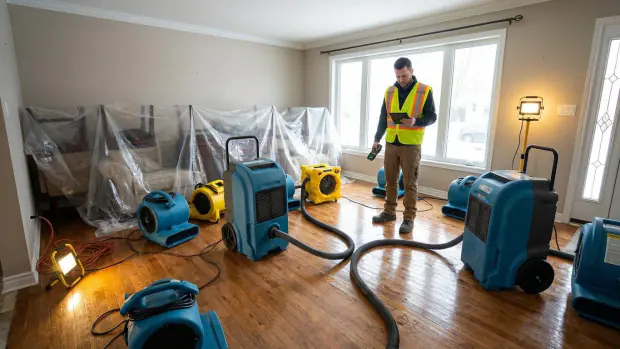
Drying is measured, not guessed. A moisture meter reading against an unaffected wall is what tells you the structure is actually dry.
The clock is the enemyMaterials that stay wet stop being a drying job and start being a remediation job.
Ask before you authoriseWe tell you what to ask a provider about licence, insurance and written scope.
Documentation mattersMoisture readings and drying logs are what an insurance adjuster actually works from.
Irving ZIPs onlyCoverage across all six residential ZIP codes in the city.
Start here
What water damage restoration actually involves
Water damage restoration is the process of removing water from a building, drying the structure back to a measured dry standard, and cleaning or removing whatever the water contaminated. It is not the same thing as repairing the leak, and it is not the same thing as replacing the flooring afterwards.
Those three jobs often get blurred together, and the confusion costs people money. A plumber fixes the pipe. A restoration provider removes the water and dries the structure. A contractor rebuilds what had to come out. Some companies do two or three of those; many do one. Knowing which one you are currently talking to is the most useful thing you can establish in the first five minutes of a phone call.
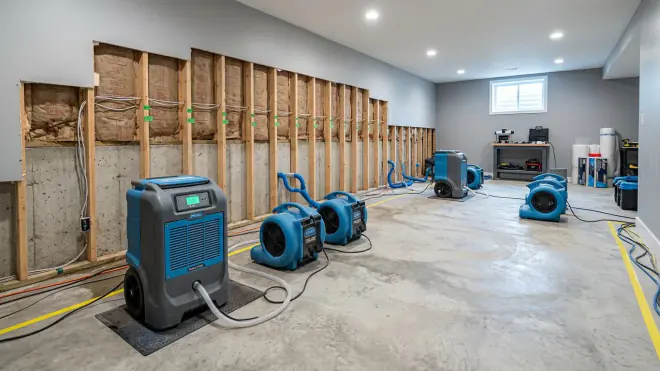
The part homeowners consistently underestimate is the drying. Pumping standing water out of a room is fast and visually satisfying — the floor looks fine again within an hour. But the water that soaked into the bottom of the drywall, the carpet pad, the subfloor seams and the cabinet kickboards is still there, and it is the part that causes the second round of damage. Proper drying runs for several days with air movers and dehumidifiers, and it is verified with a moisture meter rather than by touch.
If you already know what you are dealing with, the service breakdown below goes into each type of job in detail. If you are not sure, the symptom guide is the faster route.
Why hours matter
The first 24 to 48 hours decide how big the job gets
Water damage is one of the few property problems where the cost is driven as much by delay as by the original event. The same burst supply line produces two very different invoices depending on whether it was addressed on the day or on the weekend.
Here is the progression. In the first minutes water spreads — it finds the lowest path, runs along the slab, and goes under things. Within hours, porous materials have absorbed what they are going to absorb: drywall wicks moisture upward from the floor, carpet pad holds many times its weight in water, and particleboard cabinet bases begin to swell. Past roughly a day or two of materials staying wet, mold becomes a realistic concern rather than a theoretical one. After several days you are dealing with compounding problems — odour, staining, swollen trim, delaminating flooring, and a scope that now includes removing and replacing material rather than drying it.
Before anyone arrives
Four things worth doing yourself
Stop the water if you safely can. Find the main shut-off — on Irving slab homes it is usually at the meter box near the street or on an exterior wall. For a failed water heater, there is normally a dedicated valve on the cold inlet.
Kill power to affected areas at the breaker, but only if the panel is dry and you can reach it without standing in water. If you cannot, leave it and say so when you call.
Photograph and video everything before anything is moved. Wide shots of each room, then close-ups of the source and the damage. This is the evidence your insurer works from, and it cannot be recreated once a crew starts extraction.
Lift what you can off the wet floor. Rugs, electronics, boxes, anything with a fabric or cardboard base. Furniture legs can be put on foil or blocks to stop finish bleeding into carpet.
Do not run a household vacuum over standing water, do not walk into a room where water has reached outlets or a panel, and do not go under a ceiling that is visibly sagging and holding water.
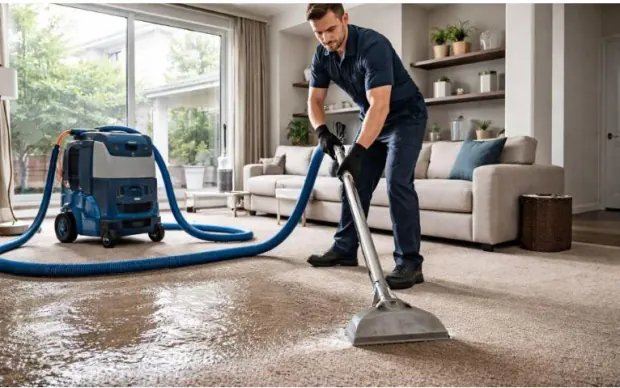
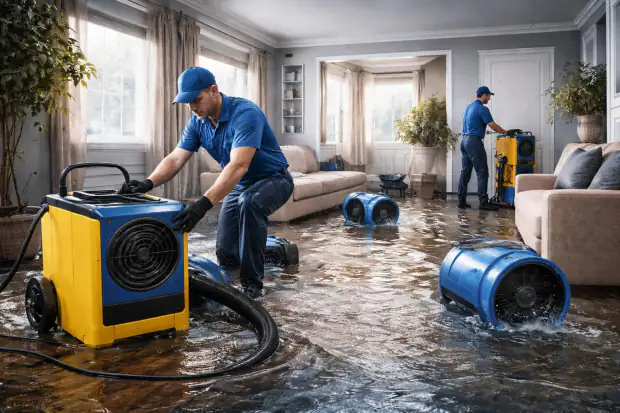
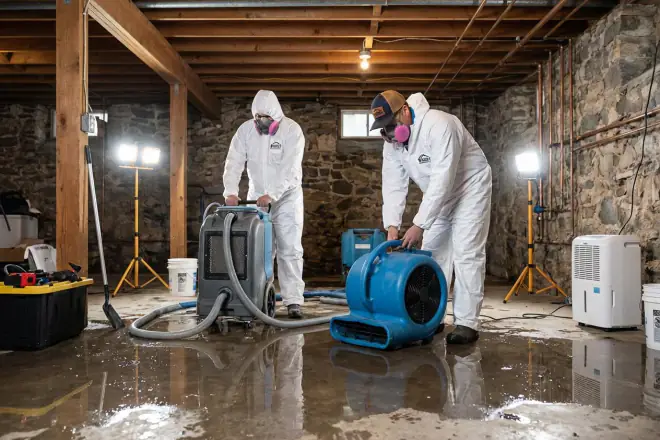
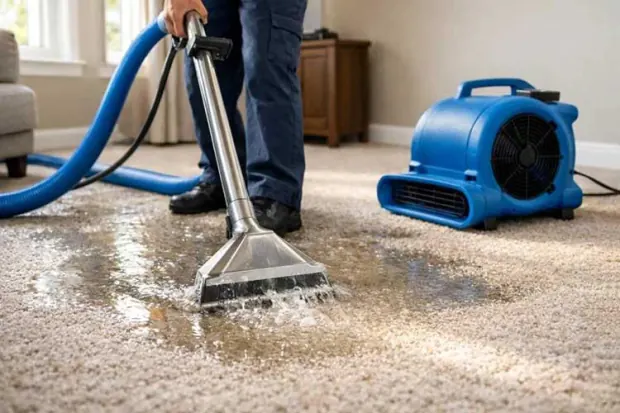
Extraction pulls the bulk water out. What soaked into the pad, the drywall and the subfloor is what the drying phase afterwards is for.
Nine distinct jobs. They overlap in equipment but differ completely in scope, urgency and how the materials get handled — which is why each one has its own page rather than a line in a list.
Emergency Water Extraction
Standing water is the first problem and the fastest one to fix. Truck-mounted and portable extraction pulls water off floors and out of carpet pad before it migrates into wall cavities.
Pumping out water is not drying. Air movers and dehumidifiers pull moisture back out of framing, drywall and slab over several days, monitored with meter readings.
Split supply lines, failed water heaters and hard-freeze ruptures. The pipe is a plumber's job; everything the water touched afterwards is a restoration job.
A brown ring on the ceiling means water has already been sitting above it. Sagging drywall holding water is a collapse risk and needs controlled release, not a bucket.
Wind-driven rain, hail-opened roofs and creek rise during a North Texas spring. Outside water arrives contaminated and is handled differently from a clean supply-line leak.
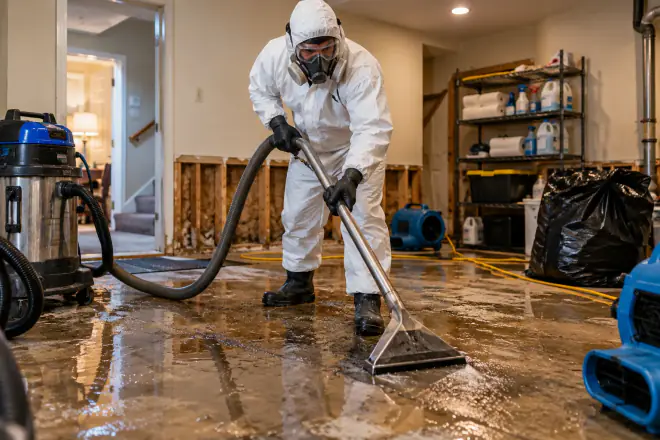
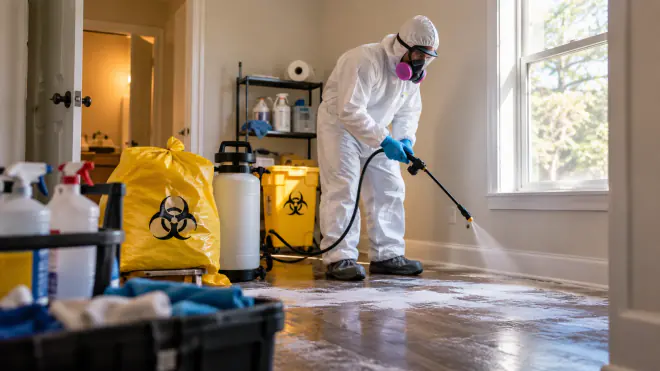
A backed-up main or overflowing toilet is Category 3 water. Porous materials it touched are generally removed rather than dried, and the area is cleaned and disinfected.
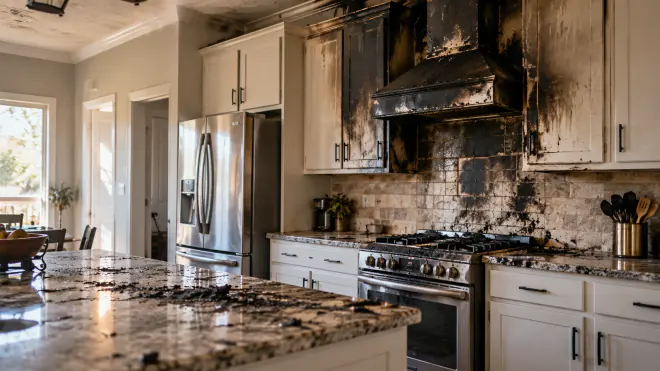
After the fire there is usually water too. Soot is acidic and keeps etching surfaces, and smoke odour settles into porous materials until it is treated.
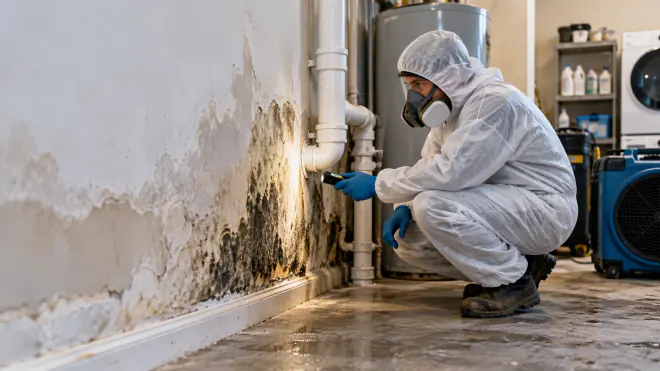
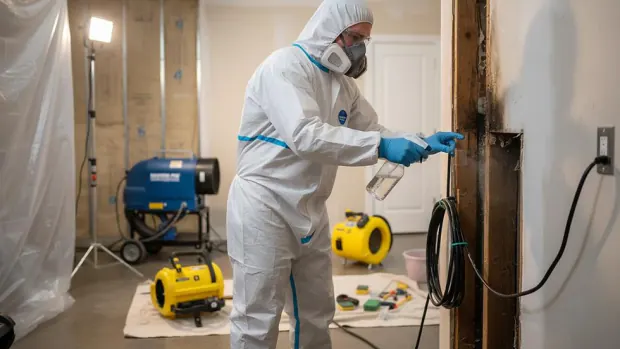
Texas licenses this work. Once mold affects 25 or more contiguous square feet, state law requires a TDLR-licensed remediator — a rule worth knowing before you hire anyone.
Not sure which service you need? Start with what you can see
Find the line that matches your situation. This is a starting point for the conversation, not a diagnosis — the provider who attends will assess the property properly.
Match what you are seeing to the service that handles it
Two situations override everything in that table. If water has reached outlets, cords or the electrical panel, treat the whole area as live and stay out of it. And if a ceiling is bulging and holding water, keep everyone out from under it — a saturated drywall ceiling can release the whole load at once.
Local causes
What actually causes water damage in Irving homes
Irving's building stock has a specific profile, and it produces a specific set of failures. The peak construction decade here was the 1980s, with the 2000s and 1990s next — so a large share of the city's homes are now running supply lines, shut-off valves and water heaters that are 25 to 45 years old.
Supply lines and water heaters reaching end of life
This is the most common cause and the most preventable. Braided washing-machine hoses, icemaker lines, toilet supply connectors and dishwasher inlets all have a service life, and they tend to fail without warning rather than with a slow drip. Water heaters are the costly version of the same story: a tank that lets go releases its full contents and then keeps feeding the leak from the supply until someone closes a valve. If a water heater in an Irving home is original to a 1980s or 1990s build, it has been replaced at least once already — and if nobody can remember when, it is worth checking the date on the label.
Hard freezes, which North Texas gets rarely and badly
Irving does not freeze often enough for its housing to be built like a cold-climate city's, and that is exactly the problem. Pipes run through unconditioned attics and along exterior walls, hose bibs go uncovered, and a multi-day hard freeze finds every one of those weaknesses at once. February 2021 remains the reference point: the Texas Department of Insurance recorded 500,196 winter-storm claims through the end of that July, 85% of them residential, with about $5.8 billion paid to policyholders. State Farm reported that the heaviest concentration of its Texas claims came from the Houston and Dallas–Fort Worth areas and were mostly for frozen and burst water pipes. A burst from a freeze is a plumbing repair and a restoration job, in that order.
Spring storms, hail and wind-driven rain
The severe-weather window here runs roughly March through June, which is also when Irving gets most of its rain — May averages close to five inches. Hail reports around the city cluster in exactly those months. The pattern that produces water damage is not usually a dramatic roof failure; it is hail bruising or lifting shingles in April, and then rain finding the opening in May or June. Wind-driven rain also gets in around window flashing and door thresholds in ways that steady vertical rain does not.
Creek rise and the Trinity floodplain
Irving sits against the Trinity River and its Elm Fork on the eastern side of the city, and three local flood-control districts hold FEMA-certified levees. The city has also been working through its interior drainage problems: the West Irving Creek Channel project removed roughly 240 homes from 100-year flood risk, and in July 2026 the Texas Water Development Board approved $35.6 million toward flood mitigation along North Delaware Creek, following around $115 million in earlier funding. That work matters, but creek-adjacent and low-lying properties still take water in a heavy event — and water that arrives from outside is treated as contaminated, which changes the whole scope. That is storm and flood cleanup, not ordinary drying.
Carpet and pad hold many times their own weight in water, which is why a floor that looks dry can still be feeding moisture into the walls around it.
Slab leaks, which hide for weeks
Dallas County sits on Blackland Prairie clay — expansive soil that swells and shrinks with moisture and moves the slab foundations nearly every Irving home is built on. That movement stresses the water lines running in and under the slab. A slab leak often produces no visible water at all for a long time. The signals are indirect: a water bill that jumped without explanation, a warm spot on the floor, the sound of running water with every fixture closed, or unexplained damp at the edge of a room. By the time it is visible, it has usually been running a while.
Apartments, condos and the unit above you
Roughly 62% of occupied homes in Irving are rented, and in the denser ZIPs it is far higher. In stacked construction the leak is frequently not yours — it arrives through your ceiling from a unit you do not control, which makes notifying building management in writing the first move rather than the last. See ceiling water damage repair for the job itself, and water damage in Las Colinas for how multi-unit losses work here.
How this works
What happens when you call this line
We would rather set the expectation accurately than oversell it. This is a referral line, so here is the actual sequence.
You call and describe it
What happened, roughly when, which rooms, whether the water is stopped, and your address or ZIP. If anyone is unsafe or water is near electrics, say so first.
We match your ZIP
We identify an independent restoration provider covering your part of Irving and the type of work involved — water, fire, mold or biohazard.
You are connected
You speak with the provider directly. Ask them for a realistic arrival window, whether they are licensed and insured for this work, and what the assessment involves.
They assess and scope
The provider inspects, takes moisture readings, identifies the water category, and gives you a written scope. Nothing should start before you have agreed to it.
Work and documentation
Extraction, drying and monitoring run on the provider's schedule. Ask for daily readings and drying logs — your insurer will want them.
Referral disclosure
Water Damage Restoration Pros is a referral service. We connect you with independent restoration providers. Service availability, response time, pricing, licensing and the work performed are the responsibility of the provider, not of this website. We do not perform restoration, remediation or repair work, we do not employ restoration technicians, and we do not set provider pricing. We also do not guarantee that a provider is available for your job at any given moment. What we provide is the connection and the information on this site to help you ask better questions.
We do not publish dollar figures, because a price given before anyone has seen the property is a guess — and a low guess quoted to win a phone call is the most common way people end up with a bill they did not expect. What we can do is show you exactly which variables move the number, so you can read a quote properly and compare two of them fairly.
The seven factors that actually determine what a water damage job costs
Factor
What it means
Why it moves the price
Category of the water
Clean supply water (Category 1), grey water from an appliance (Category 2), or sewage and flood water (Category 3).
Category 3 usually means porous materials are removed instead of dried, which adds demolition and disposal.
How far the water travelled
A contained bathroom leak versus water that crossed into three rooms, under cabinets and into a shared wall.
Cost scales with affected square footage far more than with the size of the original leak.
What the water soaked into
Tile and sealed concrete release water quickly. Carpet pad, engineered wood, laminate, insulation and cabinet kickboards hold it.
Dense materials may need specialty drying or removal — the single biggest swing factor.
How long it sat
Hours versus days. Mold becomes a realistic concern once materials stay wet, and dampness that has been present for days changes the scope.
A delayed call often converts a drying job into a drying plus remediation job.
Equipment days
Air movers and dehumidifiers are typically charged per unit per day until moisture meter readings reach the drying goal.
Bigger or wetter areas need more units for more days — this is why monitoring records matter.
Reconstruction after drying
Drying returns the structure to dry. Replacing drywall, baseboards, flooring, paint and cabinetry is separate work.
Ask whether a quote covers mitigation only, or mitigation plus rebuild.
Mold remediation, if required
Texas regulates this separately once the affected area reaches 25 contiguous square feet.
Licensed assessment and licensed remediation are generally performed by different parties.
The question that explains most quote differences
Ask: “Is this mitigation only, or mitigation plus reconstruction?” Mitigation is extraction, drying and cleaning. Reconstruction is putting back the drywall, flooring, trim and cabinetry that had to come out. Two quotes that look thousands apart are frequently quoting two different jobs. Get the scope in writing either way.
Coverage
Areas and ZIP codes we cover in Irving
Irving is not one housing market, and water damage does not behave the same way across it. A 1950s frame house near the Heritage District, a 1980s slab home in south Irving and a twelfth-floor condo overlooking Lake Carolyn fail in different ways and need different conversations.
Las Colinas, covering 75039 and 75038, is the densest and most rental-heavy part of the city — around 84% of occupied homes in 75039 are rentals — which makes stacked-unit leaks and building-management coordination the defining issue there. Valley Ranch in 75063 is the largest ZIP by land area at just over 20 square miles and the highest-income, built around a canal network with deed-restricted neighbourhoods and the gated Hackberry Creek community. North Irving, 75062, holds the Hospital District beside Baylor Scott & White Medical Center and the University of Dallas, on mature tree-lined streets where root intrusion into older service lines is a genuine factor. East Irving, 75061, is the city's most populous ZIP at nearly 56,000 people and contains the Heritage District — Irving's original townsite and its oldest housing stock. South Irving, 75060, is the most owner-occupied part of the city at roughly 65%, which changes who makes the decision when something fails.
Mail-routing and PO Box codes also listed for Irving
These codes carry mail but have no resident population of their own. If your post goes to one of them, the property itself sits inside one of the six ZIPs above — call and we will work out which.
How to vet a restoration provider before you authorise work
Water damage is a distress purchase. You are upset, the property is wet, and somebody is standing in your hallway with equipment telling you they can start right now. That is precisely the moment people sign things they have not read. Five minutes of questions is worth it.
Ask for the licence that applies. For mold work, Texas requires a TDLR mold remediation licence once the affected area reaches 25 contiguous square feet — and it is verifiable through TDLR's public licence search. Ask for the number and check it.
Ask for proof of general liability insurance, and ask for the certificate rather than a verbal assurance.
Get the scope in writing before work starts, including what is being removed, what is being dried, how many days of equipment are anticipated, and what is explicitly excluded.
Read what you are signing. Some agreements include a direction-to-pay or an assignment of benefits that transfers your insurance claim rights. That may be fine — but know you are doing it.
Ask for daily moisture readings and drying logs. A provider who takes proper readings will hand them over without hesitation. One who will not is a signal.
Be wary of pressure. Legitimate urgency sounds like “every hour this stays wet makes it worse.” Manufactured urgency sounds like “sign now or the price goes up.”
Make the call count
What to have ready when you call
None of this is required — if water is running right now, just call. But it makes the first conversation much faster.
AddressStreet address and ZIP, plus unit and floor if it applies
SourceWhat failed, and whether the water is now stopped
TimingWhen it started, as precisely as you can
SpreadWhich rooms, and roughly how much floor area
SurfacesCarpet, tile, wood, laminate — and whether cabinets are affected
InsuranceCarrier and policy number if you have them nearby
Where materials have been removed, exposed framing is cleaned and treated before anything is closed back up.
Say straight away if the water may be contaminated, or if anyone in the property has a health condition affected by damp or mold — both change the advice you will be given about staying there.
Water damage questions Irving homeowners actually ask
How fast should I act after water damage in Irving?
Immediately, and the reason is physical rather than commercial. Water keeps moving while you decide: it wicks up drywall, runs along the top of a slab, and travels under cabinets where you cannot see it. The window that matters most is the first day or two — materials that stay wet become a mold problem, and a drying job turns into a demolition-and-remediation job.
If you can do it safely, shut off the water supply and switch off power to affected circuits before you do anything else, then call.
Is this website the company that does the restoration work?
No. Water Damage Restoration Pros is a referral service. When you call (469) 960-7264, we take down what happened and where you are, then connect you with an independent restoration provider that covers your part of Irving. The provider — not this website — carries the licensing and insurance, sets the price, schedules the visit and performs the work. We tell you this up front because it changes who you should be asking questions of.
How quickly will someone actually get to my property?
We cannot promise a specific arrival time, and you should be sceptical of any referral line that does. Response depends on which independent provider takes the job, how far they are from your address, what they already have running, and whether a regional weather event has every crew in Dallas County committed at once. What we can do is get you talking to a provider quickly so you can ask them directly for a realistic time and hold them to it.
Will my homeowners insurance cover this?
It depends how the damage happened. Texas policies generally cover water damage that is sudden and accidental — a burst pipe, a failed water heater, an appliance supply line that lets go. They generally exclude gradual damage from a slow leak left unaddressed, and they exclude flood, which needs separate flood insurance.
Two things help regardless: photograph everything before anything is moved, and take reasonable steps to stop further damage. Most policies require that second one — failing to mitigate gives an insurer grounds to deny the additional damage you could have prevented.
Do I need to call my insurance company before I call you?
You do not have to, and waiting can cost you. Stopping the water and starting documentation are time-sensitive; opening a claim is not. Many people do both in parallel — call for help, photograph everything while you wait, then open the claim. Ask whichever provider attends to give you their moisture readings, a written scope and daily drying logs, because those documents are what an adjuster actually works from.
Are the restoration providers licensed and insured?
Put that question to the provider directly, before you sign anything. We do not publish licensing or insurance claims here, because we cannot verify and keep current the credentials of every independent provider taking calls.
Texas does license one part of this work specifically. Under the Texas Occupations Code, a TDLR mold remediation licence is required once mold affects 25 or more contiguous square feet, and a licensed remediator must give you the state's Consumer Mold Information Sheet before work begins — verifiable through TDLR's public licence search. For water damage work generally, ask for proof of liability insurance and a written scope before authorising anything.
What does water damage restoration cost in Irving?
We do not publish prices, because any number quoted before someone has seen the property is a guess, and quoting a number to win the call is how people end up surprised. Cost is driven by the category of the water, how far it travelled, what it soaked into, how long it sat, how many days of equipment are needed, and whether reconstruction and mold remediation are in scope. The cost factors section above explains each one.
When you get a quote, ask whether it covers mitigation only or mitigation plus rebuild. That single question explains most of the difference between two quotes that look far apart.
My home is on a slab. Can water still get under the floor?
Yes, and it is the part Irving homeowners most often underestimate. Almost all housing here is slab-on-grade, so water does not pool below you — it spreads sideways across the top of the slab, under flooring and cabinet kickboards, and wicks up the bottom of the drywall. A floor that feels dry underfoot is not evidence the structure is dry.
It is also why a slab leak can run for weeks before anything is visible, usually showing first as an unexplained jump in the water bill or a warm patch on the floor.
Can I just dry it out myself with fans and a box dehumidifier?
For a small, clean-water spill you caught immediately and dried within hours, often yes. Beyond that, household fans and a consumer dehumidifier move far less air and pull far less moisture than restoration equipment, and they do nothing for water already inside a wall cavity or under a cabinet.
The genuine risk is not that the DIY attempt fails — it is that it half-works. The surface dries, the cavity does not, and the problem reappears weeks later as a musty smell and staining, by which point it has become a remediation job. If the affected area is larger than a small bathroom, or the water was not clean, get it assessed.
Still not sure what you are dealing with? Describe it on the phone and we will point you the right way — (469) 960-7264.
Talk to someone now
Water in your Irving property? Make the call now.
Describe what happened and where you are. We will connect you with an independent restoration provider covering your ZIP code. The sooner drying starts, the smaller the job stays.