
ZIP 75063 · Valley Ranch & Hackberry Creek
Water Damage Restoration in Valley Ranch, Irving TX
75063 is the largest ZIP in Irving by land area and the highest-income, covering the canal network of Valley Ranch and the gated Hackberry Creek community. Larger, more complex homes mean longer runs of plumbing and more places for a leak to hide.
- Single-family, townhome and gated communities
- Longer plumbing runs, more concealed line
- 20.2 sq mi — the city's largest ZIP
Referral service — calls are connected to independent restoration providers. Availability, pricing and licensing are the provider's responsibility.
Valley Ranch, Hackberry Creek and the 75063 profile
ZIP 75063 is Irving's largest by a wide margin — 20.2 square miles, nearly double the next biggest — and it holds around 46,600 residents in just over 19,000 housing units. It is also the city's wealthiest, with a median household income of $117,133, well above the Irving average.
Valley Ranch itself sits north of I-635 and is known for its canal network and walking paths. The Greater Irving-Las Colinas Chamber describes it as a deed-restricted community of well-established neighbourhoods mixing single-family and multi-family housing across a range of price points. Hackberry Creek, sandwiched between Valley Ranch and Las Colinas, is a gated community built around a country club whose 18-hole course was designed by Byron Nelson.
About 37.7% of occupied homes here are owner-occupied — lower than you might expect for the income profile, because the ZIP contains a substantial amount of townhome and apartment stock alongside the detached housing. That mix means a provider working in 75063 may be dealing with a 3,000-square-foot detached home one day and a stacked townhome the next, and the jobs are not alike.
Canals, irrigation and landscape water
Valley Ranch's canal network is a defining amenity and it is professionally managed, but water-adjacent property carries a few practical considerations that properties elsewhere in Irving do not.
The more common source of trouble is not the canal itself but irrigation. Larger landscaped lots here run substantial sprinkler systems, and a failed irrigation line or a head left running against a foundation delivers a continuous volume of water directly at the slab. On Blackland Prairie clay — the expansive soil that underlies all of Dallas County — that produces differential moisture under the foundation, which is exactly what drives slab movement. Slab movement in turn stresses the water lines running through and beneath it.
It is worth understanding that chain, because it explains a pattern people find confusing: an irrigation problem outside turns into a plumbing failure inside, months later. Grading that drains toward the house, a downspout discharging at the foundation, and a sprinkler zone that over-waters one side of the property all feed the same mechanism. Fixing drainage is unglamorous and genuinely preventative.
What the year looks like in 75063
March to June is the severe-weather window. Hail reports around Irving peak in April, May and June, and May is the wettest month at close to five inches. The pattern is hail damage to a roof in spring, then water entry during a later storm. Larger roofs with multiple valleys, dormers and penetrations — common on 75063 housing — have more flashing details to fail than a simple gable roof does.
Summer brings HVAC condensate problems and the irrigation issues above. Homes with attic air handlers over finished ceilings are the ones to watch; a blocked condensate drain shows up as a ceiling stain in July or August with no rain involved.
Winter is low-frequency and high-consequence. Irving does not freeze hard often, so pipes run through unconditioned attics and garages across the whole city. When a multi-day freeze does arrive it finds all of them at once — February 2021 produced over 500,000 winter-storm insurance claims across Texas, concentrated in the Houston and Dallas–Fort Worth areas and mostly for frozen and burst pipes. Larger homes with longer attic runs and outdoor kitchens have more exposure than most.
If you travel over the winter holidays — and a reasonable number of 75063 households do — leave the heating on low rather than off, and consider shutting off the main and draining the system. A burst that releases into an empty house for a week is a different event entirely from one discovered in an hour.
Available here
Restoration services across Valley Ranch
All services are available across 75063. Concealed slab and supply-line leaks in larger homes are the most common water damage call from this area.
- Emergency Water ExtractionStanding water pumped out first
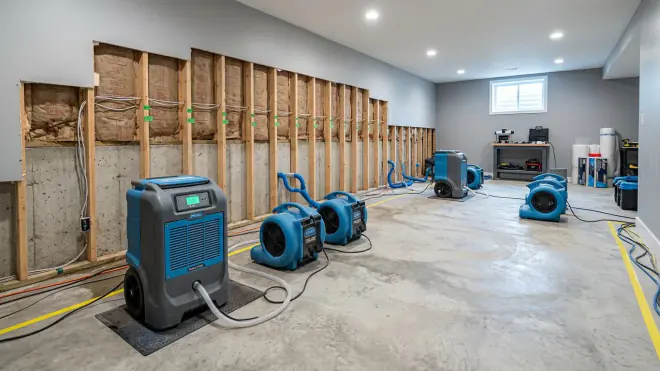
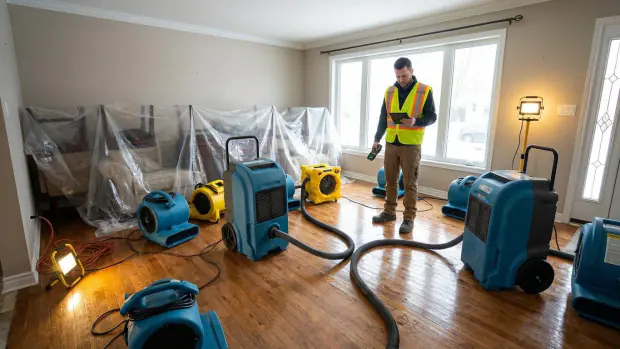
- Structural Drying & DehumidificationDrying what the pump can't reach
- Burst Pipe Water DamageSupply lines, freezes and slab leaks
- Ceiling Water Damage RepairStains, sagging and upstairs leaks
- Storm & Flood Damage CleanupCreek rise, roof and wind-driven rain
- Sewage Backup CleanupCategory 3 water, handled safely
- Fire & Smoke Damage RestorationSoot, char and odour
- Mold Removal & RemediationTexas-licensed remediation rules
- Biohazard CleanupTrauma, hoarding and contamination
ZIP codes covered on this page
- 75063
Nearby areas we also cover
- Las ColinasZIP 75039 & 75038, directly south
- North IrvingZIP 75062, to the south
- South IrvingZIP 75060, southern Irving
Much of what applies here applies citywide — the soil, the climate and the Texas licensing rules do not stop at a ZIP boundary. The citywide water damage guide has the full picture. See the full Irving coverage list, including every campaign ZIP code.
Suspect a slab leak in 75063?
Check the water meter with everything off first, then call with what you found.
Local FAQ
Valley Ranch water damage questions
How do I check for a slab leak in a large Valley Ranch home?
Start with the water meter. Turn off every fixture and appliance that uses water, then watch the meter's leak indicator or low-flow dial for a few minutes. Movement means something is running. Other signs are a warm patch on the floor, running water audible with everything off, an unexplained jump in the bill, and flooring that lifts or cups. A plumber confirms it with pressure testing and acoustic detection — worth doing rather than guessing, because slab leaks run a long time before they become visible.
Does living near the canals increase my water damage risk?
Not directly from the canals, which are managed. The more common water-adjacent factor on these properties is irrigation and drainage: a failed sprinkler line or a zone over-watering against the foundation delivers continuous water at the slab, and on Blackland Prairie clay that drives the differential soil movement that stresses slabs and the pipes running through them. Check your grading, your downspout discharge points and your sprinkler zones.
I have two water heaters. Does that double the risk?
In practice, slightly more than double — not because the units fail more often, but because the second one is usually in a less-visited location. A tank failure in a main utility room gets noticed quickly. The same failure in a guest-wing closet can run for a long time. Check both annually, note the manufacture dates, and know where both shut-off valves are before you need them.
Is Hackberry Creek covered on this page?
Yes. Hackberry Creek sits within 75063, between Valley Ranch to the north and Las Colinas to the south, and is covered here. Gated-community access does add a step — give the provider the gate details and any contractor registration requirement when you call, so they are not held at the entrance while your floor stays wet.
What should I do before leaving the house for winter holidays?
Leave the heating on low rather than switching it off — a cold house is how attic and exterior-wall pipes freeze. Insulate attic and garage pipe runs, cover hose bibs, and open cabinet doors under sinks on exterior walls. For longer absences, shutting off the main and draining the system removes the risk almost entirely. If someone can check the property mid-trip, that is worth arranging — a burst discovered after a week is a vastly bigger loss than one discovered in an hour.
Still not sure what you are dealing with? Describe it on the phone and we will point you the right way — (469) 960-7264.
Talk to someone now
Water damage in Valley Ranch or Hackberry Creek?
Describe what you have found and where. We will connect you with an independent restoration provider covering 75063.
(469) 960-7264Referral service — calls are connected to independent restoration providers. Availability, pricing and licensing are the provider's responsibility.