
Category 3 water · health hazard
Sewage Backup Cleanup in Irving, TX
A drain backing up into a bathroom or a main line surcharging into a property is not a cleaning job. It is grossly contaminated water, it carries real health risk, and the porous materials it touched generally come out rather than get dried.
- Main line backups, toilet overflows, floor drains
- Leave the area and keep children and pets out
- Containment, PPE and regulated disposal
Referral service — calls are connected to independent restoration providers. Availability, pricing and licensing are the provider's responsibility.
What sewage backup cleanup involves
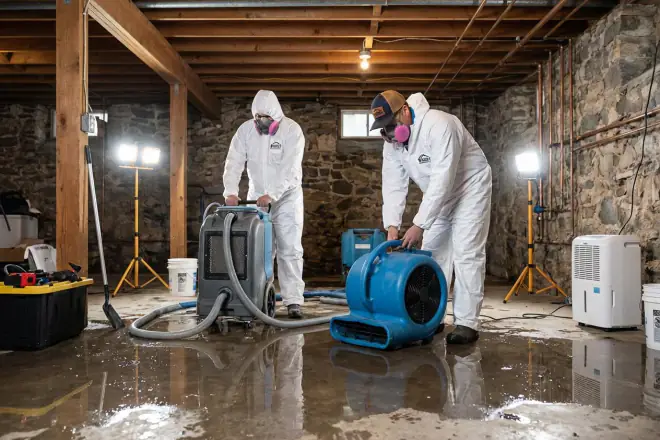
Sewage backup cleanup is the removal, decontamination and drying of a property affected by grossly contaminated water — removing the sewage, removing the porous materials it penetrated, disinfecting what remains, and drying the structure. It is governed by the contamination, not by the volume.
Restoration practice classifies sewage as Category 3 water: grossly contaminated, containing pathogenic and toxigenic agents. That classification is not a formality — it changes the whole method. A hundred litres of clean supply water across a bathroom floor is a straightforward extract-and-dry job. The same hundred litres of sewage is a containment job with protective equipment, material removal, disinfection and regulated disposal.
The principle that drives the cost is this: contamination cannot be reliably removed from the inside of a porous material. You can disinfect the surface of tile or sealed concrete. You cannot disinfect the interior of carpet pad, drywall, particleboard or insulation, because the contaminated water is inside the material's structure. So those materials are removed and disposed of. Anyone offering to shampoo sewage-affected carpet and call it done is proposing something that does not work.
Why it is treated as a health hazard
Sewage carries bacteria, viruses, parasites and fungi, and exposure routes include direct contact, ingestion via contaminated hands or surfaces, and inhalation of aerosolised particles — which is why disturbing it carelessly makes the exposure worse rather than better.
Some people are at materially higher risk and should not be in the property at all until it has been handled: infants and young children, older adults, pregnant people, anyone immunocompromised or on immunosuppressive treatment, anyone with a respiratory condition such as asthma or COPD, and anyone with an open wound. Say so when you call if any of these apply — it affects the advice you will be given about whether to stay in the property.
- Do not use a household or shop vacuum on sewage. It aerosolises contaminated material and contaminates the machine permanently.
- Do not run fans or the HVAC system in the affected area. You will distribute contaminated aerosol through the property.
- Do not use the plumbing while a backup is active — every flush adds to it.
- Do not mix cleaning chemicals. Bleach and ammonia produce toxic gas.
- Do not let children or pets into the area, even briefly.
What causes sewage backups in Irving
Root intrusion into older service lines
The lateral line running from a property to the city main is the owner's responsibility, and on older properties it is often clay or cast iron with joints that tree roots exploit. Roots find the moisture, enter at a joint and grow into a mass that catches everything passing. This is a particular factor in Irving's older neighbourhoods — the Heritage District area in 75061 contains the city's original townsite and its oldest housing, and the mature tree-lined streets around the Hospital District in 75062 combine established trees with older service lines.
Grease and the things that should not be flushed
Cooking grease poured down a drain solidifies as it cools and narrows the line until something catches. Wipes marketed as flushable do not break down the way toilet paper does and are a leading cause of blockages in both private laterals and municipal systems.
Line collapse and settlement
Blackland Prairie clay swells and shrinks with moisture, moving everything buried in it. Over decades that movement cracks, offsets and collapses older sewer laterals. It is the same soil behaviour that stresses slab foundations and the supply lines running through them — see burst pipe water damage.
Heavy rain and system surcharge
During intense rainfall, groundwater infiltration into the sewer system can exceed capacity and cause surcharge, pushing water back up through the lowest fixture in a property — usually a shower, a ground-floor toilet or a floor drain. If a backup coincides with a major storm, this is the likely mechanism, and it may be combined with storm water entry.
Fixture and appliance failures
An overflowing toilet, a failed ejector pump in a basement-level fixture, or a blocked branch line. Contained ones are smaller jobs, but the water is the same category and gets handled the same way.
How the cleanup runs
Assessment and containment
Affected area isolated with physical containment. HVAC shut down so contamination is not distributed. Crew in appropriate PPE.
Source stopped
The backup has to be cleared before cleanup is meaningful — usually a plumber's job, by cabling, hydro-jetting or camera inspection to find a collapse or root mass.
Gross contamination removed
Solids and contaminated water extracted with dedicated equipment and disposed of under the applicable waste rules.
Affected porous material removed
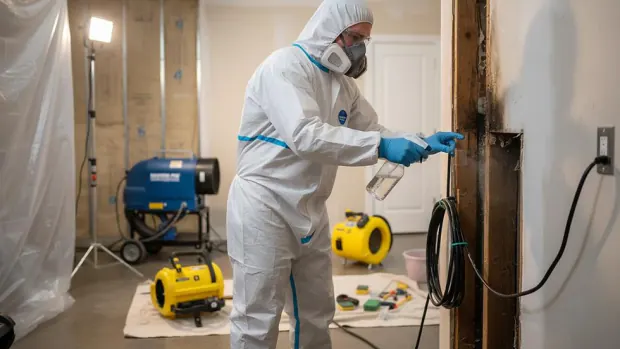
Carpet, pad, affected drywall cut back above the contamination line, insulation, particleboard, and affected contents. Bagged and disposed of as regulated waste.
Cleaning and disinfection
All remaining surfaces cleaned, then treated with appropriate antimicrobial agents. Cleaning comes first — disinfectant applied over soil does not work.
Structural drying
Air movers and dehumidifiers to a measured drying goal, with the structure opened up. See structural drying.
Verification and rebuild
Final readings documented, then reconstruction of what was removed.
What can be saved and what cannot
| Material | Typical outcome | Why |
|---|---|---|
| Carpet and carpet pad | Removed | Highly porous; contamination penetrates throughout. Pad in particular cannot be decontaminated. |
| Drywall | Removed, cut back above the line | Wicks contaminated water upward; the interior cannot be disinfected. |
| Insulation | Removed | Holds contaminated water, dries very slowly, cheap to replace. |
| Particleboard and MDF | Removed | Swells and delaminates; porous throughout. |
| Tile, sealed concrete, metal, glass | Cleaned and saved | Non-porous surfaces can be properly cleaned and disinfected. |
| Solid hardwood | Case by case | Sometimes salvageable if contact was brief and surfaces are sealed. Often not. |
| Upholstered furniture and mattresses | Normally disposed of | Porous and in close human contact. Rarely worth attempting. |
| Clothing and textiles | Case by case | Some can be professionally laundered at high temperature. Items with foam or padding usually cannot. |
| Documents and photographs | Specialist only | Specialist restoration exists but is expensive. Worth it only for genuinely irreplaceable items. |
This is the part that upsets people most, and understandably. A provider recommending removal of a great deal of material is usually following the contamination logic rather than inflating the job — but you are entitled to ask them to explain the reasoning item by item, and a good one will.
Insurance and sewage backup
This is a genuine gap in many policies. Standard homeowners insurance frequently excludes sewer and drain backup unless a specific endorsement has been added — often called water backup or sewer backup cover. It is typically inexpensive, it is commonly sold with a modest limit, and a great many people discover they do not have it at the worst possible moment.
Points worth knowing:
- Check whether your policy has the endorsement and what the limit is. Limits are often well below the cost of a serious backup.
- Where a municipal main failure caused the backup, the city may have a claims process — separate from your insurer, usually with its own notification deadline.
- Document everything before anything is removed: photographs, video, and an itemised list of what is discarded.
- Keep the provider's written scope and disposal documentation. Both matter for a Category 3 claim.
- Where the cause was a long-term blockage rather than a sudden event, expect the gradual-versus-sudden argument to arise.
Sewage in the property?
Close the door, keep children and pets out, and call. This is not a job to attempt yourself.
FAQ
Sewage backup questions
Can I clean up a sewage backup myself?
For anything beyond a very small, immediately contained overflow on a hard surface — no, and this is one of the few places we would say that flatly. Sewage is grossly contaminated water with genuine pathogen exposure risk, cleaning it without proper PPE and containment spreads it, and household vacuums aerosolise it. The porous materials it soaked into need removing rather than cleaning, which is not a realistic DIY task.
Does my homeowners insurance cover sewage backup?
Often not without a specific endorsement. Standard policies commonly exclude sewer and drain backup, and cover is added via a water backup endorsement that is usually inexpensive but frequently carries a limit well below a serious loss. Check your declarations page for it now rather than later. If a municipal main caused the backup, the city may have its own claims process with its own deadline.
How long does sewage cleanup take?
Removal and decontamination typically take one to three days for a contained residential backup, followed by structural drying that runs its own course against moisture readings — often several days more. Reconstruction of what was removed is a separate timeline. A larger backup, or one that reached several rooms and got under cabinets, extends all three phases.
Why does so much have to be thrown away?
Because contamination penetrates porous materials and cannot be reliably removed from inside them. Surface disinfection works on tile, sealed concrete, metal and glass. It does not work on carpet pad, drywall, insulation or particleboard, where the contaminated water is inside the material's structure. Removal is the only reliable approach for those. You are entitled to ask a provider to justify each item, and a good one will.
Is my house safe to stay in during the cleanup?
It depends on the extent, whether the affected area can be properly contained, and who is in the household. A contained backup in one bathroom with good isolation may be manageable. A backup across living areas usually is not. Anyone immunocompromised, pregnant, elderly, very young, or with a respiratory condition should stay elsewhere until clearance. Raise this with the provider on day one — and check whether your policy includes additional living expenses.
What caused the backup, and will it happen again?
The common causes are root intrusion into an older lateral, grease and non-flushable wipes, line collapse from soil movement, and system surcharge during heavy rain. Which one it was matters for recurrence, so ask the plumber to camera the line after clearing it. A root mass that was cabled through will regrow; a collapsed or offset section will keep catching debris. Cleanup without diagnosis means you will see it again.
Still not sure what you are dealing with? Describe it on the phone and we will point you the right way — (469) 960-7264.
Related work
Services that often come with this one
Sewage backups overlap with several other jobs depending on what caused them and what the water reached.
A backup is the most contaminated water you are likely to meet, but the drying principles that follow it are shared. Irving water damage restoration explains that wider process.
- Emergency Water ExtractionStanding water pumped out first
- Biohazard CleanupTrauma, hoarding and contamination
- Structural Drying & DehumidificationDrying what the pump can't reach
- Storm & Flood Damage CleanupCreek rise, roof and wind-driven rain
Where we cover in Irving
Older service lines and mature street trees make root intrusion a real factor in parts of Irving — the sort of local detail that changes what caused your backup.
Talk to someone now
Sewage backup in your Irving property?
Do not try to clean it yourself. Call and we will connect you with an independent provider equipped for Category 3 work in your ZIP code.
(469) 960-7264Referral service — calls are connected to independent restoration providers. Availability, pricing and licensing are the provider's responsibility.