
Creek rise · hail · wind-driven rain
Storm & Flood Damage Cleanup in Irving, TX
Water that arrives from outside is a different job from a burst pipe. It carries whatever it crossed to get to you — soil, fuel, fertiliser, sewage overflow — which means most porous material it touched gets removed rather than dried.
- Roof, window and threshold entry
- Outside water is treated as contaminated
- Flood is excluded from standard homeowners policies
Referral service — calls are connected to independent restoration providers. Availability, pricing and licensing are the provider's responsibility.

Why storm and flood water is handled differently
Storm and flood damage cleanup is the removal of externally-sourced water and everything it contaminated, followed by decontamination and structural drying. The defining difference from a clean-water loss is that the water itself is treated as hazardous.
Restoration practice classifies water by how contaminated it is. Clean supply water from a burst pipe sits at one end. Ground water and flood water sits at the other, alongside sewage — it has crossed soil, roads, lawns treated with fertiliser and pesticide, storm drains and whatever else was in its path, and in a significant event it may be mixed with sanitary sewer overflow.
That classification drives the entire scope. With clean water, the default is to dry materials in place and save what you can. With flood water, the default reverses: porous materials that absorbed it — carpet, pad, insulation, particleboard, the lower section of drywall — are generally removed and disposed of rather than dried, because contamination cannot be reliably removed from the inside of a porous material. That is why a flood job costs more than a clean-water job over the same floor area, and why a provider proposing simply to dry out a flooded room should be questioned.
How storm water gets into Irving properties
Hail first, rain later
Irving's severe-weather window runs roughly March through June. Hail reports around the city cluster squarely in those months, with April, May and June the busiest, and the largest recorded stone in local records at over four inches. Hail rarely puts water in a house on the day. What it does is bruise or lift shingles and damage flashing, and then the next heavy rain — May averages close to five inches, the wettest month of the year — finds the opening. If hail passed over your street this spring, the roof is worth inspecting before the storms arrive, not after.
Wind-driven rain
Rain driven horizontally behaves nothing like rain falling vertically. It gets past window flashing, under door thresholds, into weep holes in brick veneer and around penetrations that shed water perfectly well in ordinary conditions. This is a common and frequently misdiagnosed source — the water appears at the base of a wall rather than the top, so people look for a plumbing leak.
Creek rise and the Trinity floodplain
Irving sits against the Trinity River and its Elm Fork along the eastern edge of the city, and three local flood-control districts maintain FEMA-certified levees. Interior drainage is the more common issue for residential property. The city has been working through it steadily: the West Irving Creek Channel project removed roughly 240 homes from 100-year flood risk, and in July 2026 the Texas Water Development Board approved $35.6 million toward flood mitigation along North Delaware Creek, protecting more than two dozen homes, on top of around $115 million in earlier funding.
That work is real and it matters. It does not make creek-adjacent property immune, and it does not help with the more ordinary problem of a street that drains slowly in a heavy downpour and pushes water across a threshold.
Roof and gutter failures during a storm
Blocked gutters overflow back against fascia and into the roof structure. A failed valley or chimney flashing lets water into the ceiling cavity. Attic entry presents in the room below as a ceiling stain, often some distance from the actual entry point.
Safety first, and this is not boilerplate
- Do not walk into standing flood water. You cannot see what is in it, you cannot see what is under it, and if it has reached outlets or the panel the whole volume may be energised.
- Do not use a generator, pump or extension lead in or near standing water without the circuit isolated.
- Treat it as contaminated. Gloves and boots if you must be near it, hands washed properly afterwards, and children and pets kept out entirely.
- Watch for gas. If you smell gas, leave the property and call the utility from outside.
- Do not turn the power back on until a qualified electrician has checked anything the water reached.
- Do not enter a structure showing damage — shifted framing, a sagging roofline, a bowed wall.
From a safe position, photograph and film everything — including the exterior, the water line on the walls and the route the water took in. If it is safe and rain has stopped, covering a damaged roof section limits further entry, and most policies require you to take reasonable steps to prevent additional damage. Keep every receipt.
The flood insurance gap most people discover too late
This is the part that catches Irving homeowners out, and it is worth being blunt about.
Standard homeowners insurance does not cover flood. Flood — water that arrives from outside, rising ground water, creek or river overflow, surface water — requires a separate flood policy, typically through the National Flood Insurance Program or a private flood insurer. If you do not hold one, a genuine flood loss is generally not covered, regardless of how comprehensive your homeowners policy feels.
What your homeowners policy usually does cover is storm damage that is sudden and accidental and enters from above: wind lifting shingles and rain coming through the opening, a tree limb through the roof, hail damage. The practical distinction an adjuster applies is whether the water came in from above or rose from below.
- Water entering through a storm-damaged roof — usually a homeowners claim.
- Water rising from a creek or street across a threshold — usually a flood claim, which needs flood cover.
- Both in the same event — two claims, two adjusters, and documentation of which water went where becomes genuinely important.
NFIP policies normally carry a waiting period before cover begins, so buying after a forecast does not help. If your property is creek-adjacent or in a low-lying part of the city, that is a decision to make on a calm day.
How storm and flood cleanup runs
Safety and structural check
Electrical and gas hazards identified, structural stability assessed, water category confirmed before anyone enters.
Stop further entry
Temporary roof covering, board-up of broken openings, diversion of surface water where possible.
Contaminated water extraction
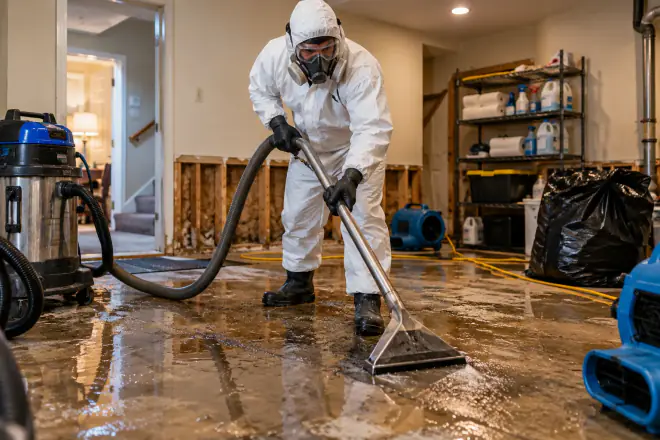
Pumping and extraction with appropriate PPE and controlled disposal of the removed water.
Removal of affected porous material
Carpet, pad, insulation, particleboard and the lower section of drywall — generally removed rather than dried, cut back above the water line.
Cleaning and decontamination
Remaining structure cleaned and treated with appropriate antimicrobial products.
Structural drying
Air movers and dehumidifiers to a measured drying goal, with the structure now opened up. See structural drying.
Reconstruction
Insulation, drywall, flooring, trim and paint replaced. Separate scope.
After the water: the mold window
Flood damage has a second phase that arrives weeks later, and it catches people who thought the job was finished. North Texas humidity, a building that has been soaked, and material that was dried imperfectly or closed up too early is a reliable recipe for mold.
The protective measures are unglamorous and effective: remove porous material that absorbed contaminated water rather than trying to save it, cut drywall back above the visible water line rather than exactly to it, remove wet insulation entirely, and do not rebuild until readings confirm the framing is dry — not until it looks dry.
If a musty smell develops in the weeks after a flood, or staining appears on new work, get it assessed rather than painted over. In Texas, remediation becomes licensed work once mold affects 25 or more contiguous square feet. See mold removal and remediation.

Storm water inside the building?
Do not wade through standing water. Call and describe what you can see from a safe position.
FAQ
Storm and flood damage questions
Does homeowners insurance cover flood damage in Texas?
Generally no. Flood — rising ground water, creek or river overflow, surface water — is excluded from standard homeowners policies and requires separate flood insurance, usually through the NFIP or a private flood insurer. Storm damage that enters from above, such as rain through a wind-damaged roof, is normally a homeowners claim. The adjuster's practical test is whether the water came in from above or rose from below.
Can flooded carpet be saved?
Almost never, and you should be wary of anyone who says otherwise. Flood water is classed as grossly contaminated, and carpet and especially carpet pad are porous — contamination gets inside the material where cleaning cannot reliably reach. The standard approach is removal and disposal. Hard surfaces such as tile and sealed concrete can usually be cleaned and saved.
How is flood water different from a burst pipe?
Contamination. Burst pipe water is clean supply water, so the default is to dry materials in place and save what you can. Flood water has crossed soil, roads and storm drains and may include sewage overflow, so the default reverses: porous materials get removed. Same volume of water, very different scope, very different cost.
Is my Irving property at flood risk?
It varies a lot across the city. Irving borders the Trinity River and its Elm Fork on the east, with three flood-control districts holding FEMA-certified levees, and the city has invested heavily in interior drainage — the West Irving Creek Channel project removed roughly 240 homes from 100-year flood risk, and North Delaware Creek received $35.6 million in state funding in July 2026. For your specific address, check the FEMA Flood Map Service Center and the City of Irving's flood management information rather than relying on a general answer.
What should I do first after a storm?
Safety before anything. Do not enter standing water, do not restore power to anything the water reached until an electrician has checked it, and leave immediately if you smell gas. Then photograph and film everything from a safe position, including the exterior and the water line on the walls. If it is safe and the rain has stopped, covering a damaged roof limits further entry — and most policies require you to take reasonable steps to prevent additional damage.
How long does flood cleanup take?
Longer than a clean-water loss of the same size, because material removal and decontamination happen before drying can start. Removal and cleaning typically take a few days; drying then runs its own course against moisture readings, often a week or more because the structure is wetter and the humidity load is higher. Reconstruction is a separate timeline again, and after a regional event it is affected by how many other properties are queued ahead of you.
Still not sure what you are dealing with? Describe it on the phone and we will point you the right way — (469) 960-7264.
Related work
Services that often come with this one
Storm water finds more than one way in, and what it damages depends on the route it took.
Storm water is one of several ways a building gets wet, and it is handled differently from the rest. How water damage restoration works in Irving sets out the other causes and the response each one needs.
- Emergency Water ExtractionStanding water pumped out first
- Ceiling Water Damage RepairStains, sagging and upstairs leaks
- Sewage Backup CleanupCategory 3 water, handled safely
- Mold Removal & RemediationTexas-licensed remediation rules
Where we cover in Irving
Flood exposure varies enormously across Irving — creek-adjacent and low-lying properties behave very differently from higher ground in the same city.
Talk to someone now
Storm water in your Irving property?
Describe what came in and from where. We will connect you with an independent restoration provider covering your ZIP code.
(469) 960-7264Referral service — calls are connected to independent restoration providers. Availability, pricing and licensing are the provider's responsibility.